Bombas Shark Tank Update 2026: From $200K Deal to $2B+ Brand

Key Takeaways
- Daymond John invested $200,000 for 17.5% equity in Bombas during the Season 6 premiere on September 26, 2014, after initially demanding 20% and negotiating down from the founders’ original 5% ask at a $4 million valuation.
- Bombas became the most successful brand in Shark Tank history, with Daymond John’s initial $200,000 investment now estimated to be worth between $100 million and $598 million depending on dilution.
- The company achieved approximately $325 million in revenue in 2024, projected $500 million for 2025, surpassed $2 billion in lifetime sales by early 2026, and now carries a valuation between $3.42 billion and $3.5 billion.
- Bombas has donated over 150 million essential clothing items to a network of 4,000 giving partners across all 50 states through its core “buy one, donate one” business model.
- The brand opened its first physical retail stores in October 2025 on Bleecker Street in NYC, followed by locations in Boca Raton, Florida (late October 2025) and Austin, Texas (mid-November 2025), marking a major shift from its digital-first strategy.
- Footwear became a breakout category, with the Sunday Collection slippers and slides growing to represent nearly 20% of the entire Bombas business by late 2025.
- Jason LaRose was appointed CEO in May 2025 , a retail industry veteran who took over from co-founder David Heath, who transitioned to Executive Chairman to focus on broader strategic initiatives.
Founders & Background
Bombas was co-founded in 2013 by David Heath and Randy Goldberg. The duo originally met in 2011 while working at the digital media and lifestyle brand UrbanDaddy. Bonding over their shared entrepreneurial ambitions and diverse career experiences, they ultimately left the media industry to build a mission-driven apparel brand.
David Heath
David Heath currently serves as the Executive Chairman of Bombas, having transitioned from his long-time role as Chief Executive Officer in May 2025. Raised in an entrepreneurial family, Heath developed a passion for business early on and refined his foundational sales skills working as a top performer for Cutco Knives. He attended Babson College, an institution highly regarded for its business curriculum, where he earned a Bachelor of Science with majors in Marketing, Management, and Entrepreneurship in 2005. Before launching Bombas, Heath worked as the Director of Business Development at UrbanDaddy and spent time on the new media acquisitions team at Yucaipa Companies. Proving his drive as a serial entrepreneur, his early independent ventures prior to the sock industry included founding companies such as Talking Owls LLC and the luxury ingredient supplier Regalis Foods.
Randy Goldberg
Randy Goldberg serves as the Co-Founder and Chief Brand Officer of Bombas, directing the company’s creative vision, product design, and brand identity. Like Heath, Goldberg grew up in a family of business owners in Michigan, experimenting with childhood retail ventures like building and selling PVC hockey nets. He graduated from Georgetown University’s McDonough School of Business in 2000 with a Bachelor of Science in Finance. Prior to co-founding Bombas, Goldberg built a successful career in digital advertising and branding. He worked extensively as a copywriter and consultant for global corporate brands, including Nike, Sony, and vitaminwater. He also led creative development at UrbanDaddy and launched his own niche retail projects, most notably co-founding Pop Up Flea, a highly curated traveling menswear market.
Origin Story and Motivation
The motivation to start a buy-one-give-one sock company was unexpectedly sparked by a single social media post. In early 2011, Heath scrolled past a Facebook post stating that socks were the number one most requested clothing item at homeless shelters. Because socks cannot legally or hygienically be donated used, unhoused individuals treat them as a rare luxury, leading to chronic shortages at community organizations. Initially, Heath and Goldberg responded to this revelation by simply purchasing multi-packs of athletic socks and handing them out to homeless individuals on their commutes to work.
The founders quickly realized that direct personal charity was not a scalable solution to a nationwide problem. Inspired by the “one-for-one” business models popularized by companies like TOMS and Warby Parker, they decided to create a premium commercial product to sustainably fund their philanthropic mission. Heath and Goldberg spent two years meticulously researching and developing a re-engineered athletic sock to ensure high consumer demand would drive continuous charitable donations. They named the new company “Bombas,” which is derived from the Latin word for bumblebee. The founders chose this name because bees work collaboratively in a hive to improve their surrounding world, a concept that perfectly captured their vision for a community-focused business.x This collaborative philosophy remains woven into the company’s culture through their core mantra, “Bee Better,” which is stitched into the inside of every single item they produce.
Current product categories include:
- **Socks:** Everyday, performance athletic, and high-performance “Bombas Sport” lines.
- **Underwear:** For men, women, and children, including specialized bralettes.
- **Apparel:** Premium cotton T-shirts and loungewear basics.
- **Footwear:** Slippers, outdoor-style slides, and shoes.
Pre-Shark Tank History
Before seeking outside capital, co-founders David Heath and Randy Goldberg spent approximately two years in a rigorous research and development phase. Heath bootstrapped the initial development by investing roughly $18,000 of his personal savings to create a minimum viable product. They focused heavily on solving the common pain points associated with traditional athletic socks, testing 137 different iterations before finalizing their engineered design.
When Bombas officially launched to the public, the company debuted with a highly focused line of just 16 stock keeping units (SKUs). The initial product range consisted strictly of athletic ankle and calf socks. Early designs deliberately avoided simple solid colors, instead featuring black or gray base materials highlighted by vibrant neon accents in pink, blue, yellow, and green to establish a distinct visual identity for the young brand. Positioned as a premium alternative to mass-market commodity multipacks, the retail pairs were initially priced between $9 and $12.
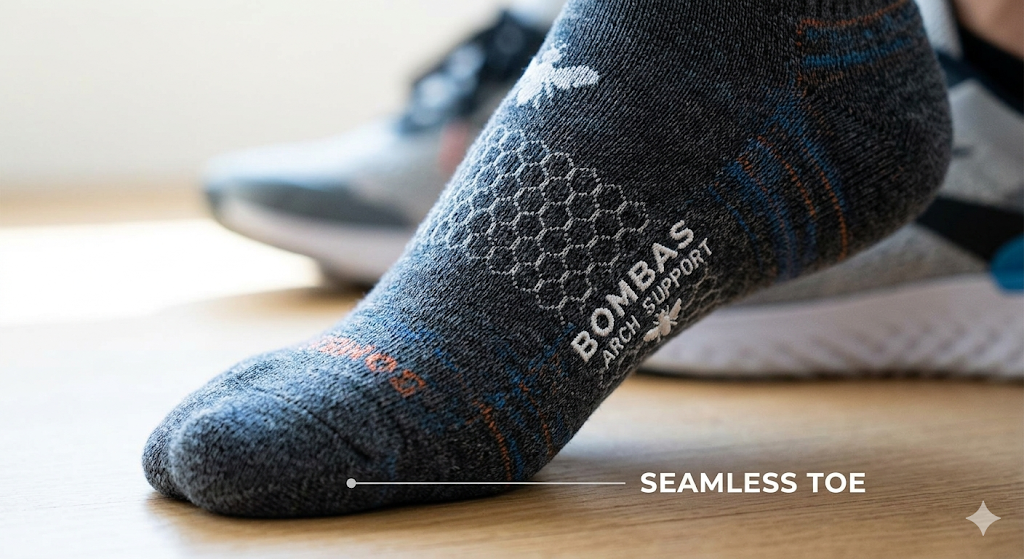
The launch product featured seven specific technical improvements, including a knit mid-foot compression system called the “Honeycomb Arch Support” and “Blister Tabs” to prevent shoe friction. Additional innovations included hand-linked seamless toes to eliminate irritation, Y-stitched heels to create a natural foot cup, and a “Stay-Up Technology” tension system designed specifically for the calf styles. marketer.club Furthermore, the founders engineered a completely separate version of the sock exclusively for their charitable donations. unl.edu These donation pairs were manufactured in darker colors to mask dirt, treated with antimicrobial coatings to prevent odor and fungus, and built with reinforced seams to withstand heavy wear in high-stress environments.
Bombas officially entered the market in August 2013 through a 30-day crowdfunding campaign on Indiegogo. Setting a modest initial goal of $15,000 to fund their first major production run, the campaign quickly validated their social enterprise model by raising over $25,000 in under 24 hours. unl.edu By the end of the 30-day period, the brand had successfully secured approximately $145,000 from nearly 2,800 individual backers. Following this viral success, the founders utilized the capital to build their proprietary direct-toconsumer e-commerce website and fulfill their initial orders.
The early market response rapidly outpaced the startup’s initial inventory capabilities, with the company achieving roughly $400,000 to $500,000 in early sales over its first several months of operation. To scale production and meet the surging consumer demand, Bombas secured approximately $1 million in seed funding from a network of friends, family, and angel investors. This successful seed round and the strong early revenue metrics gave the founders a powerful proof of concept as they prepared to tape their impending appearance on national television.
Shark Tank Appearance
Bombas made its national television debut on September 26, 2014, featured in the premiere episode of Shark Tank’s sixth season. Co-founders David Heath and Randy Goldberg entered the Tank seeking an investment of $200,000 in exchange for a 5% equity stake, effectively valuing their young startup at $4 million. They pitched their re-engineered athletic socks and their core “buy-one-give-one” philanthropic mission, explaining that socks were the most requested clothing item at homeless shelters.
- **The Ask:** $200,000 for 5.00% equity
- **The Deal:** $200,000 for 17.50% equity
- **The Shark:** Daymond John
The founders entered the pitch with extreme preparation, having compiled a spreadsheet of 300 potential questions based on every previous episode of the show.This rigorous preparation allowed them to remain calm and control the narrative, intentionally wording their answers to prompt the exact follow-up questions they wanted to address.
Despite their polished presentation, the founders faced immediate and intense skepticism from the panel of Sharks. Kevin O’Leary was their most vocal critic, infamously referring to the founders as “sock cockroaches” attempting to survive in a heavily commoditized retail market. O’Leary criticized their $4 million valuation as “ludicrous” and argued that their charitable model of giving away half of their product was essentially a massive tax on their profits.
The other Sharks shared similar concerns regarding the company’s scalability and tight margins. Robert Herjavec doubted the brand could successfully compete against massive athletic giants like Nike or Under Armour, while Lori Greiner felt the initial $9 to $12 retail price point was simply too high for mass consumer adoption. Mark Cuban opted out due to concerns over high customer acquisition costs in the crowded e-commerce space, and Greiner further disagreed with the founders’ strategy to use the investment capital to hire outside sales specialists.
Fortunately, the pitch resonated with Daymond John, whose extensive background in the apparel industry with FUBU gave him a unique appreciation for their product and margins. John saw the potential of their high-performance sock and recognized the brand-building power of their social mission. However, he required a much larger piece of the company than the founders initially offered, starting negotiations by demanding a 20% stake.
After the founders countered with 15%, the two parties ultimately agreed on a final on-air deal of $200,000 in exchange for 17.5% equity. Crucially, John also agreed to provide financing for their inventory, a strategic addition that helped the founders manage the massive surge in orders that inevitably followed their television appearance. While reports indicate that John and the founders slightly renegotiated certain terms privately during the due diligence phase, the partnership officially closed and catalyzed Bombas’ transformation into an apparel powerhouse.
Post-Shark Tank Update
When Bombas first aired on national television, the immediate wave of consumer interest overwhelmed their technical infrastructure and caused their website to crash. Co-founder David Heath watched helplessly as product images broke and checkout flows failed, resulting in thousands of dollars in lost sales. To permanently resolve this early setback, Bombas migrated its direct-to-consumer platform to Shopify. In its first year on the new platform, the company saved $108,000 in platform costs and successfully scaled to meet the massive influx of new customers. This “Shark Tank effect” ultimately catapulted Bombas into becoming the most successful brand in the show’s history. Daymond John’s initial $200,000 investment for a 17.5% equity stake is now estimated to be worth between $100 million and $598 million, depending on dilution from subsequent capital raises.
To sustain its explosive post-show trajectory, the company secured several major rounds of private financing. In June 2018, Great Hill Partners acquired a significant stake in the business to help accelerate its growth. This was followed by a substantial $150 million Series C funding round in March 2021. This massive Series C round was led by Third Point Ventures, with additional participation from Broadlight Capital, Irving Investors, and Vanterra Capital. More recently, in June 2024, the company reportedly raised approximately $70.56 million in a private equity growth round, which was part of a larger $256 million capital strategy.
Flush with capital, Bombas began a multi-year transition from a digital-first startup into an omnichannel apparel giant. While direct-to-consumer sales remain a powerful engine, the brand aggressively expanded its wholesale channels by securing placements in major retailers like Target, Nordstrom, and Dick’s Sporting Goods. To provide a tactile brand experience, Bombas opened its very first permanent physical retail store in New York City in October 2025. By early 2026, this retail footprint expanded to include new brick-and-mortar locations in Austin, Texas, and South Florida. The company also pushed into international markets, notably prioritizing the Canadian market for both retail sales and localized giving partnerships in 2025. Beyond geographic growth, product diversification has been a massive revenue driver, with the footwear segment experiencing over 70% growth in 2025.
Despite its triumphs, Bombas has faced ongoing macroeconomic and operational hurdles over the years. Rising costs for digital customer acquisition have squeezed direct-to-consumer profitability, forcing the brand to rely more heavily on its newer wholesale distribution channels. Supply chain volatility has also presented a challenge, particularly as new trade policies and a 10% tariff on Chinese imports hit the apparel sector in early 2025. Additionally, the sheer operational complexity of scaling their core “One Purchased, One Donated” mission requires manufacturing and distributing millions of specially designed donation items to homeless shelters, adding logistical costs that traditional competitors avoid. The massive scale of their operations is evident in their supply chain payments, with roughly 50% of the company’s payments now going to international vendors.
Today, Bombas operates with remarkable financial strength and maintains highly profitable double-digit EBITDA margins. After achieving approximately $325 million in revenue in 2024, the company’s revenue projections climbed to roughly $500 million for 2025. Early 2026 data indicates continued momentum, with the company’s lifetime cumulative sales surpassing the $2 billion mark.
The private company’s valuation is now widely estimated to sit between $3.42 billion and $3.5 billion. To manage this massive scale, Bombas employs a workforce whose estimated headcount ranges between 146 and 385 employees across various departments. techlist.ai This corporate maturation culminated in a major leadership transition in May 2025, when retail veteran Jason LaRose was appointed CEO, allowing founder David Heath to step into the role of Executive Chairman.
Products & Market

While Bombas originally built its reputation on a single re-engineered athletic sock, the company’s product architecture has evolved into a comprehensive lifestyle and apparel portfolio. Today, the brand’s offerings extend far beyond calf and ankle socks to include premium underwear, bralettes, and t-shirts. One of the most successful recent category expansions has been the brand’s push into loungewear and footwear. The “Sunday Collection” features popular indoor and outdoor styles such as the Sunday Plush Slipper, Sunday Plush Slide, and Sunday Mule Slipper. This footwear segment has accelerated rapidly, growing to represent nearly 20% of the entire Bombas business by late 2025.
The company has also made strategic moves to capture the highly lucrative activewear market. Bombas recently launched a dedicated performance sub-line called “Bombas Sport,” which offers specialized socks meticulously designed for running, skiing, hiking, and studio workouts. This performance segment now accounts for roughly 20% of total sock revenue, and the category has driven a nearly 40% year-over-year increase in new customer acquisition. To maintain cultural relevance and aesthetic appeal, the brand frequently engages in unique partnerships, such as a spring 2026 maximalist capsule collection with designer Susan Alexandra that features colorful floral embroidery and interchangeable ankle charms.
The Bombas target market is heavily rooted in what industry observers describe as an “empathy economy.” The brand appeals to consumers who demand premium comfort but also want their purchases to carry moral weight and social impact. This intense customer loyalty is anchored by the company’s core “buy one, donate one” business model. By adhering to this mission, Bombas has donated more than 150 million essential clothing items to a vast network of 4,000 giving partners serving unhoused individuals across all 50 states.
For over a decade, Bombas successfully captured this target audience almost exclusively through its direct-toconsumer (DTC) digital platforms. This online-first approach was a massive success, driving the company to surpass $2 billion in lifetime revenue. However, executive leadership recognized that digital-only brands inevitably face an ultimate growth ceiling due to the rising costs of online customer acquisition. Furthermore, internal market data revealed that a staggering 65% of all sock purchases in the United States still occur in physical retail environments.
To address this reality, Bombas aggressively expanded its omni-channel wholesale strategy by carefully curating product assortments for specific retail partners. The brand positions its fashion-forward merchandise at Nordstrom and focuses heavily on its performance and sport lines at Dick’s Sporting Goods. Ahead of the 2025 holiday shopping season, Bombas deepened its wholesale footprint by securing placements in Target and Designer Shoe Warehouse (DSW). The Target partnership focuses on basic family apparel, exposing the brand’s core items to a massive mainstream audience. Conversely, the DSW rollout is strategically “footwear forward,” capitalizing on the shoe retailer’s authority to showcase Bombas’ booming slipper and slide collections.
Moving beyond third-party wholesale, Bombas officially entered the proprietary brick-and-mortar retail space in late 2025. The company opened its first-ever physical store in October 2025 on Bleecker Street in New York City’s West Village. This flagship opening was quickly followed by two additional locations at the Town Center in Boca Raton, Florida, and The Domain in Austin, Texas.
To facilitate this physical expansion, Bombas partnered with Leap, Simon Property Group, and Shopify. Leap’s Retail-as-a-Service platform manages the end-to-end store operations, staffing, and design, which significantly reduces the capital expenditure and risk traditionally associated with commercial leases. Meanwhile, Shopify provides the unified technology to sync online and offline commerce, and Simon supplies the premium, high-traffic real estate.
Bombas views these physical locations as “brand theater,” utilizing warm lighting, tactile materials, and gentle storytelling to create an emotionally resonant shopping experience. This carefully crafted physical environment allows consumers to tangibly verify the brand’s long-standing digital promises of comfort and generosity. By blending a powerful social mission with a robust omni-channel retail network, Bombas has successfully transitioned from a niche startup into a dominant force in the modern apparel market.
Media & Coverage
In 2025 and early 2026, business media and trade publications heavily documented Bombas’ strategic pivot from a digital-first direct-to-consumer (DTC) startup into an omnichannel retail powerhouse. Press coverage highlighted the appointment of Jason LaRose as Chief Executive Officer as a defining moment in the brand’s corporate maturation. LaRose explained the necessity of this operational shift to major news outlets, noting that “more than 60% of socks in this country are sold in physical locations” and emphasizing that “the wholesale opportunity is big for us.” Discussing the launch of their proprietary brick-and-mortar stores, LaRose told industry reporters that physical retail is a “natural and exciting next step in bringing the Bombas brand, products, and mission to more people in new ways.” He described the new storefronts as a form of “brand theater” and an essential opportunity to tell their full corporate story. “This is really a test for us to see how customers respond to our product and physical space that we’re controlling,” LaRose stated, adding that the brand plans to be highly thoughtful regarding future geographic expansions. Furthermore, regarding their massive wholesale push into mass-market retailers like Target, LaRose noted, “A huge swath of the overall population shops there.”
Alongside their retail expansion, a significant portion of Bombas’ recent press coverage has focused heavily on their staggering philanthropic milestones. Media reports and corporate case studies have highlighted that Bombas officially surpassed 150 million items donated, with recent distribution figures rapidly pushing past the 200 million mark. To commemorate these achievements, the brand launched a highly publicized out-of-home (OOH) marketing campaign across New York City. This bold advertising push featured eye-catching statistics regarding local homelessness and directed viewers to a dedicated microsite featuring interviews with individuals sharing their lived experiences. By placing these advertisements in high-traffic subway stations and sidewalks, marketing experts praised Bombas for using outdoor media not just for brand visibility, but to actively humanize the cause it supports and deepen its community connection. Analysts point out that this highly quantified impact allows Bombas to maintain an authentic brand perception, successfully avoiding the “social washing” critiques that often plague other purpose-driven apparel companies.
Financial and retail industry reports have also closely tracked the brand’s successful product category diversification. When discussing the launch of the new “Bombas Sport” sub-line, LaRose told footwear publications that the company wanted to definitively showcase what it means to be a great performance brand across activities like running, skiing, and hiking. This strategic push into the activewear market has been highly successful, with reports indicating that the share of new customers shopping at Bombas Sport increased by almost 40 percent year-over-year. Additionally, media coverage surrounding their new partnership with Designer Shoe Warehouse (DSW) highlighted the explosive growth of their footwear and slipper segment. Explaining the strategic alignment with DSW, LaRose stated, “They’re a real authority when it comes to footwear, and our footwear business has accelerated so much over the last few years, probably close to 20% of our business this year.” Ultimately, recent industry narratives view Bombas as the absolute pinnacle of Shark Tank success, noting that the brand’s rare ability to maintain double-digit profit margins while scaling to approximately $500 million in annual revenue sets a new benchmark for modern mission-driven retail.
Current Status (as of 2026)
Bombas is operating highly successfully as of 2026, demonstrating sustained momentum long after its legendary Shark Tank debut. The apparel brand recently surpassed an impressive $2 billion in lifetime revenue. Furthermore, it maintains highly profitable double-digit EBITDA margins, with overall sales growing by 22% during its 2025 fiscal year. To guide the brand’s next chapter of corporate maturation, retail industry veteran Jason LaRose was officially appointed as Chief Executive Officer in May 2025. Following this executive transition, cofounder David Heath moved into the role of Executive Chairman to focus on broader strategic initiatives.
Regarding its corporate structure and capitalization, Bombas remains a privately held entity with no immediate plans announced for an initial public offering (IPO) or acquisition exit event. The brand’s explosive operational growth has been carefully fueled by strategic private equity and venture capital investments over the years. Its total funding to date is anchored by a massive $150 million Series C capital raise completed in March 2021.
This pivotal growth round was led by Third Point Ventures, with additional financial participation from Broadlight Capital, Irving Investors, and Vanterra Capital.
A major milestone defining the company’s current 2026 status is its aggressive and highly publicized expansion into proprietary physical retail. Internal consumer data revealed that roughly 65% of all sock purchases in the United States are still made in person at physical locations. To capture this massive market share, Bombas officially opened its first-ever brick-and-mortar store on Bleecker Street in New York City’s West Village in October 2025. This flagship debut was rapidly followed by a second retail location at the Town Center in Boca Raton, Florida, in late October 2025. A third dedicated storefront subsequently launched at The Domain in Austin, Texas, in mid-November 2025. CEO Jason LaRose has described these new retail locations as “brand theater,” allowing customers to tangibly interact with the company’s expanding product portfolio.
To successfully execute this complex transition from an online-first startup to a physical retailer, Bombas formed a unique strategic collaboration with Leap, Simon Property Group, and Shopify. Leap provides a modern Retailas-a-Service platform that manages the end-to-end operational heavy lifting, from store design and technology to daily staffing. Meanwhile, Simon Property Group supplies the premium, high-traffic commercial real estate required to attract high-intent consumers. Finally, Shopify delivers the unified commerce backend necessary to seamlessly sync the brand’s physical sales with its digital footprint. The brand has relied heavily on Shopify’s infrastructure since migrating its website following its infamous post- Shark Tank traffic crash, a move that initially saved the company $108,000 in platform costs. Today, this robust technology stack allows Bombas to scale its brick-and-mortar presence with unprecedented speed and significantly reduced financial risk.
Legal & IP Notes
Bombas LLC actively maintains a robust intellectual property portfolio that heavily relies on design patents to protect its unique aesthetic configurations. The company’s foundational IP includes U.S. Patent D723261, which legally protects the specific visual construction of its original re-engineered athletic sock. As the brand diversified its product lines, it successfully secured additional design protections for its growing intimates category. Notable recent filings include multiple design patents for “Underwear with pouch with curved double darts,” including Patent D1103567 which was officially granted in December 2025. Alongside these formal patents, Bombas fiercely protects its proprietary design features—such as its Honeycomb Arch Support System, Blister Tabs, and seamless toes—as specialized trade dress and highvalue branding assets.
To secure its brand identity globally, Bombas holds registered trademarks for its primary “BOMBAS” wordmark, its signature stylized bee logo, and its philanthropic “BEE BETTER” slogan. The company actively expands this portfolio to align with new market entries, most notably securing the “BOMBAS SPORT” trademark to shield its expanding performance apparel division. ipaustralia.gov.au In late 2025 and early 2026, international intellectual property offices published official acceptances of the “BOMBAS SPORT” mark under Class 25 for clothing and footwear. The Australian Government officially registered this specific trademark to Bombas LLC, granting the brand localized legal protection in the region until November 2035. The brand actively defends these valuable assets through the Trademark Trial and Appeal Board (TTAB), frequently opposing potentially confusing applications as seen in its Bombas LLC v. Just Bee Queen, LLC dispute.
Beyond intellectual property, the company navigates various legal and compliance challenges typical of a massive omnichannel retail operation. In March 2026, a civil rights class action lawsuit, Young v. Bombas LLC , was filed in the Southern District of New York alleging that the company’s e-commerce website was not fully accessible to visually impaired consumers using screen readers under the Americans with Disabilities Act. Historically, the brand has also litigated data privacy disputes, successfully navigating class-action allegations related to a previous customer data breach in the Pygin v. Bombas, LLC case. To combat the rising financial threat of sophisticated counterfeiting, Bombas employs an aggressive brand protection strategy utilizing AI-driven visual detection and “Schedule A” litigation to instantly freeze fraudulent merchant payment accounts. This anti-counterfeiting legal strategy includes active international law enforcement cooperation, evidenced by the brand’s direct involvement in a massive April 2024 raid on Pandabuy counterfeit warehouses in China.
Final Thoughts
Bombas is a rare Shark Tank success story that combined:
- Strong product quality
- Emotional branding
- A powerful social mission It proves that purpose-driven businesses can scale massively.